


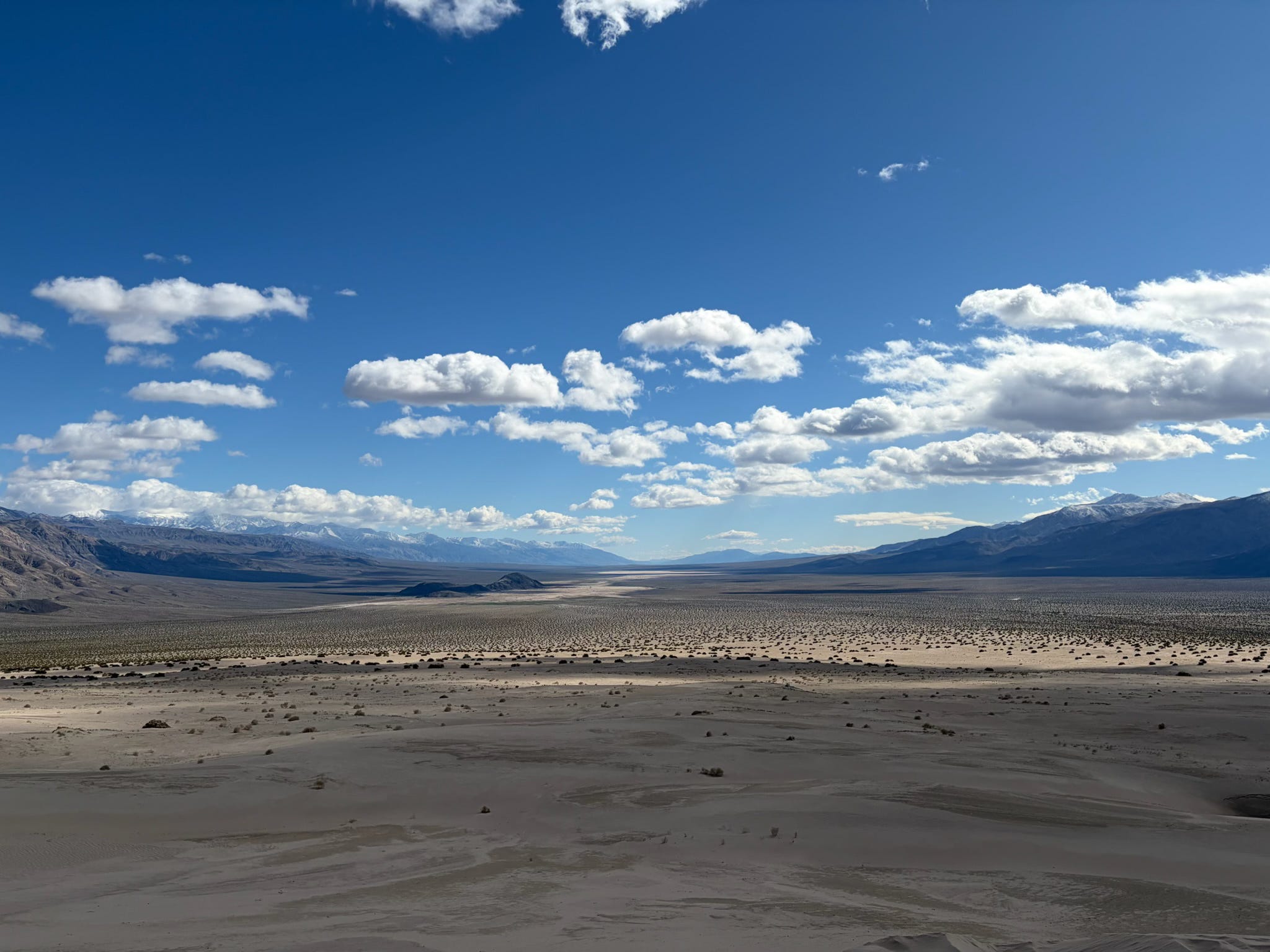
We drove in from the west, through the Panamint Valley, the road dropping fast enough that both my wife’s and my ears popped. My daughter was asleep in the backseat. Outside, rust colored rock, layers of it, each band a different era of the earth displaying its indifference to human timelines.
I thought about how hot this place gets in summer. 130 degrees, the kind of heat that warps your understanding of what a planet can do and I felt grateful for February.
As we drove north on Trona Wildrose Road, we passed the stunning Trona Pinnacles entrance. Ancient tufa spires rising from a dry lakebed like something from another planet. Then, almost without warning, the landscape shifted.
A massive industrial site came into view. Searles Valley Minerals has been mining soda ash, borax, and potassium sulfate from this lakebed for over 150 years. A coal-fired power plant sits alongside it, still running.
These kinds of extraction sites leave lasting scars on the land, the air, and the communities nearby. The small town of Trona carries that weight daily.
Progress has a price. And it’s rarely paid by the people who profit from it.
We were headed to Ballarat. A mining ghost town on BLM land. One small whimsical sign marking its importance, describing what’s left of the adobe ruins, how a 1908 car race from Paris to New York passed through, and describing it’s last resident.
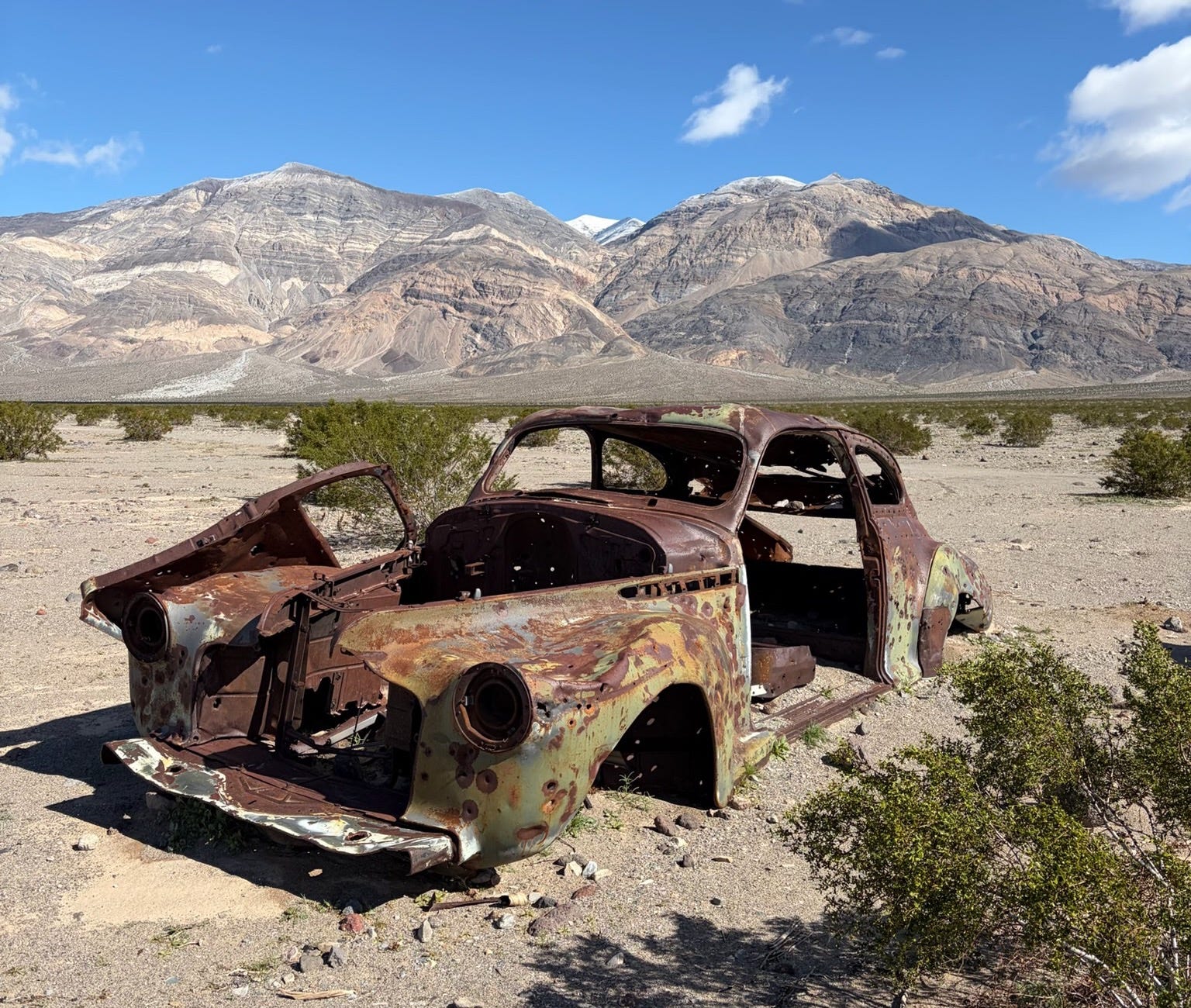
Rusted mining equipment still sits where someone abandoned it a hundred years ago, patient as geology, waiting for nothing. We set up our tent nearby, caught a beautiful sunset, and called it home.


The next day we drove into Death Valley to hike. Dante’s View was our trailhead. That’s when the wind found us.
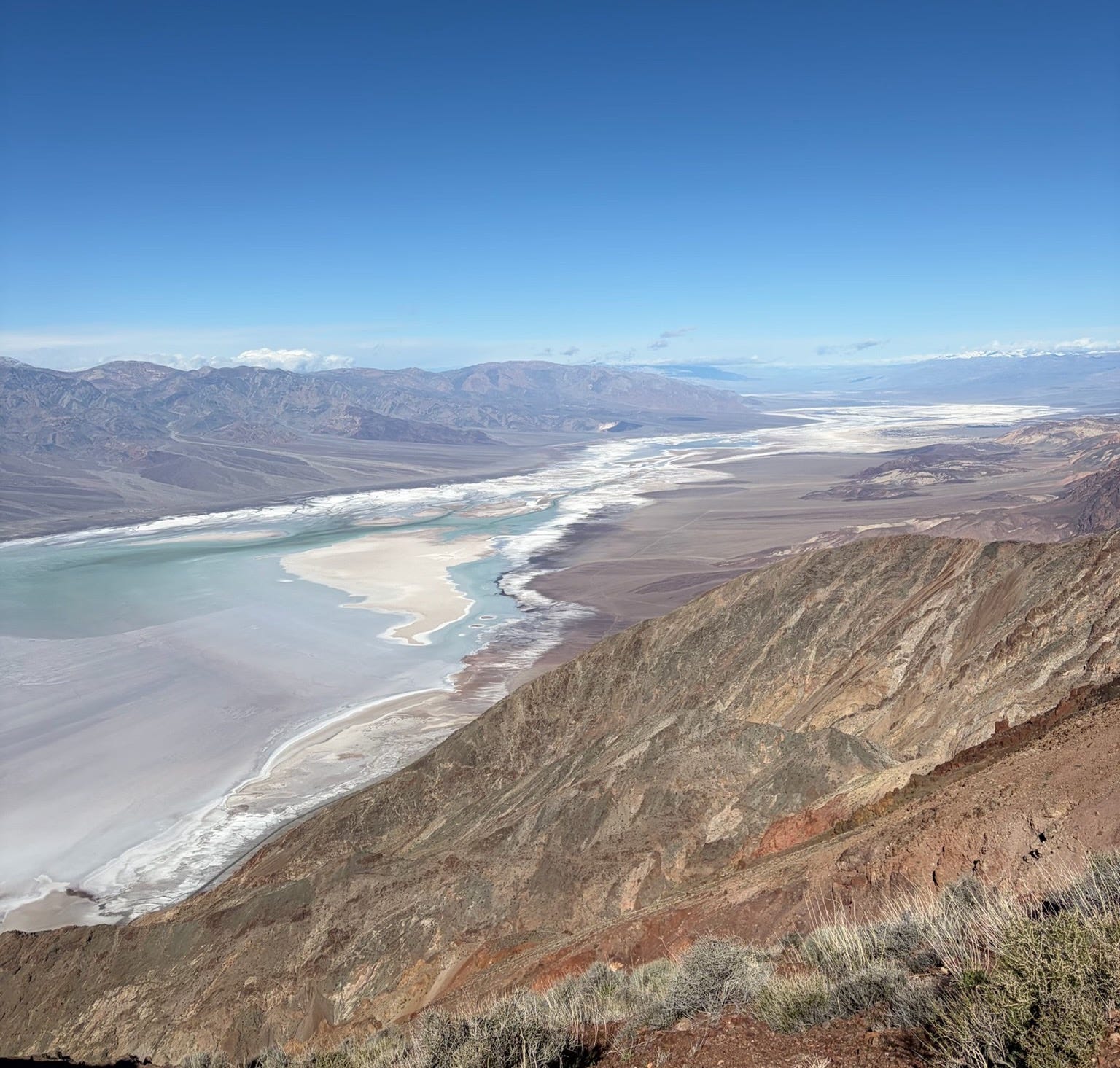
It came across the salt flats in visible sheets. White plumes lifting off Badwater Basin and moving fast, low to the ground, rising against the Black Mountains and disappearing into the rock. It was one of the stranger things I've ever seen. A valley exhaling. What we were watching is a documented process called aeolian transport wind pulling fine salt, gypsum, and mineral particles off the playa and carrying them miles into surrounding ranges.
Scientists have tracked the same phenomenon at planetary scale: Saharan dust crosses the Atlantic and deposits phosphorus into Amazon soils, effectively fertilizing one of the most biodiverse places on earth from one of the most barren. The romance of that is real.
But the science is honest about the other side too. The dust can coat plant leaves, block the pores they breathe through, salinize soil past what anything can tolerate. This is a process these salt flats and mountains have seen for centuries. I wanted to learn more but found no studies about aeolian processes in this area. Ultimately, it’s a natural process and whether we have studied it or not, it's just matter in motion, and what the mountain does with it depends on how much arrives and when.
But that day, the wind was just wind, and my daughter hated it. The wind was from the huge February snow storm front in the Sierra’s. We had her in the backpack carrier and she started crying immediately.
My wife and I looked at each other. Stressed by her tears. Two years ago we would have pushed through. We’re both wired that way: finish the hike, hit the summit, log the miles. There’s a competitiveness to it that we don’t always admit is competitiveness. But something has shifted in us since she was born, some recalibration of what counts as a good day outside, and so we turned around slightly disappointed, but without much discussion and went to look at the Artist’s Drive instead.
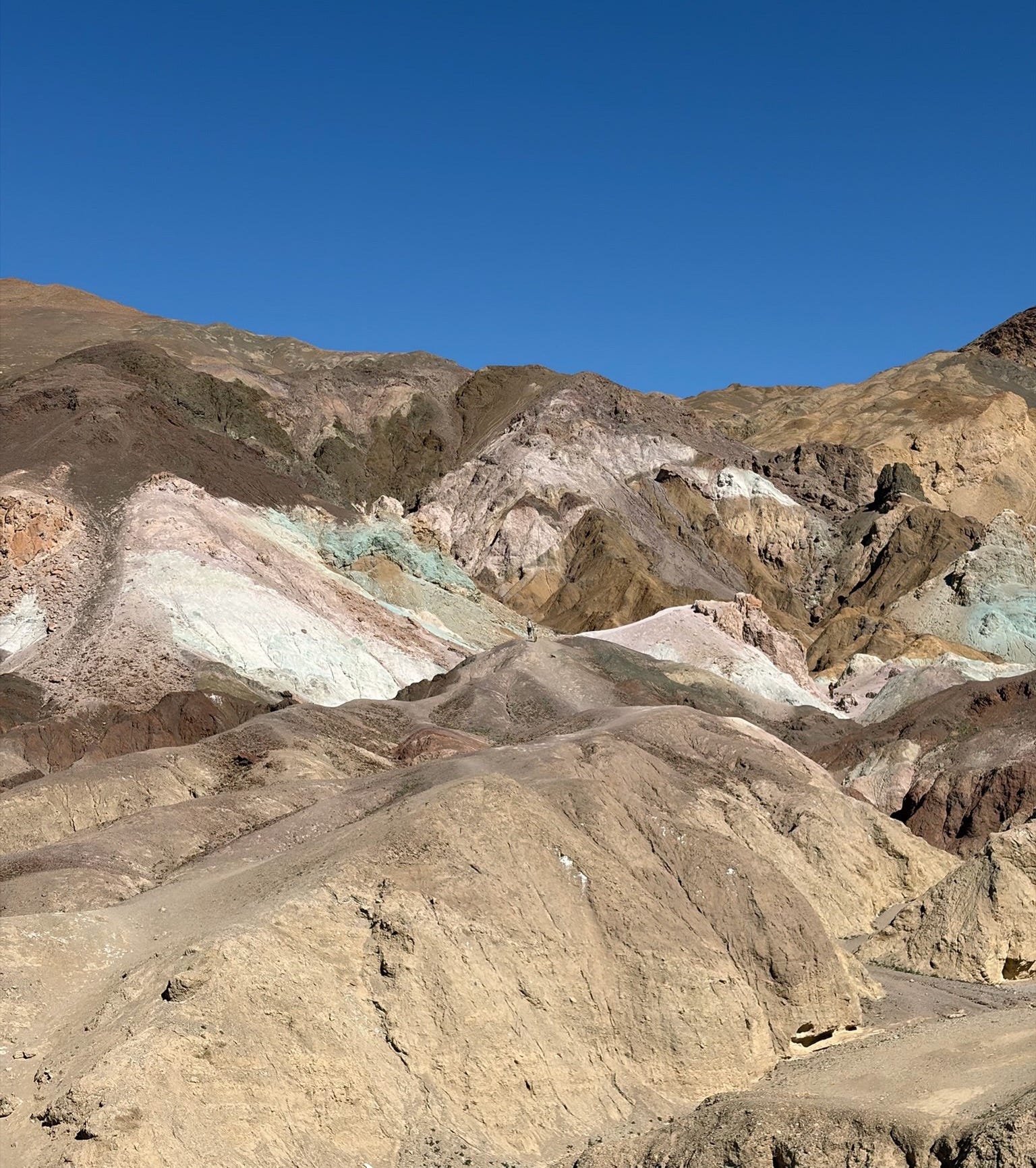
The colors there are almost unreasonable. Green from chlorite, purple from manganese, pink from iron oxide. A hillside that looks like someone mixed geological time with a sunset. We walked slowly. The canyons blocked the wind. She was happy. We weren’t keeping score.
That night, back at camp, our daughter was cold. That’s the honest version of the trip. My birthday came and went while I lay awake listening to her breathe in the dark, touching her cheek to check her temperature, doing the math on blanket layers.
There’s a kind of love that feels most like fear, and fatherhood has introduced me to it fully. She did great on her first “test” camp and the next day we retreated to a motel nearby and I felt grateful for a successful night.
But the land. The land stayed with me.
We walked on a sand dune north of Ballarat that held no other footprints. Thirty or so miles east, Death Valley National Park was packed with license plates from multiple states, tour buses, the whole democratic circus of a place people have agreed matters. It had the same sky. Same silence. Same salt lifted by the same wind. The difference was a line on a map and a decision someone made in Washington.
This is the thing about BLM land that people don’t discuss enough: it is yours. Two hundred and forty-five million acres of it, managed by the federal government on behalf of present citizens and the mandate actually says this, future generations. Stewardship across time. Which is a radical concept to sit with in a desert that has already outlasted every human intention brought to it.
What does it mean to hold land in trust for someone not yet born? It means the decisions we make now about extraction, about access, about whether we fund the agencies that manage these places are decisions we’re making on behalf of my daughter, who slept cold in a tent and didn’t know she was inheriting anything. We walked on ground that Timbisha Shoshone people knew for thousands of years before the government drew lines around it. The stewardship question is older than the BLM, older than the country. We arrived at it recently.
I think about the contrast, the packed park, the empty BLM land thirty miles away, and I don’t think the answer is to redirect traffic. These quiet places are partly beautiful because they require something: a little research, some comfort with ambiguity, a willingness to exist somewhere without a visitor center telling you what to feel. But I think about who gets to feel that comfort, and it isn’t everyone. Access is economic. Cultural. Informational. Who taught you these places existed? Who gave you the gear, the long weekend, the confidence that the land was for you?
The wind that lifted salt off the valley floor and carried it up into the Panamint Range didn’t ask who owned the mountains. It just moved, carrying what it could, potentially feeding what was above it.
My daughter is a one year old. She’ll inherit whatever we leave her. She slept under Telescope Peak not knowing any of this. That’s probably fine. That might be the whole point.
Thank you for reading! I highlight threats to public lands and the energy industry’s impact. I believe clean energy is the future, and ALL energy projects should prioritize private land first to keep wild places wild. When energy extraction is needed on public lands all projects must restore the land after extraction. Public lands are unique and once lost, they’re gone forever.