


On a March afternoon, a camera bolted to a tower out in Arizona’s Coconino National Forest caught something on the horizon. A little smudge. Could’ve been a cloud. Could’ve been dust.
It wasn’t. It was the first breath of what became the Diamond Fire. The software flagged it, a human looked and agreed, the firefighters got there fast, and the whole thing was out before it crossed seven acres.
We’re supposed to cheer. AI caught the fire. Crisis averted. And near homes, near families, the extremely hot fires, sure. A huge save.
But sit with it a beat longer than the press release wants you to. Notice what the AI is actually doing. It’s watching. A camera on a tower, on public land, looking out over a national forest. Just watching. Hold that picture, because by the end of this the machine won’t be watching the forest anymore. It’ll be standing on it. Drinking it.
First, though, a harder question creeps in.
Should we always put it out?
Fire isn’t always the enemy. We just decided it was.
Most of us were never taught this part. A huge chunk of this continent didn’t tolerate fire, it needed it. Low, cool fires clear out underbrush, recycle nutrients into the soil, crack open the canopy and let some light through. Some trees literally can’t reproduce without it: lodgepole pine, giant sequoia, their cones sealed shut until the heat pops them and drops the seeds. The longleaf pine savannas of the Southeast are some of the most biodiverse places on the continent, and the reason is they burned every couple of years. Indigenous peoples burned on purpose, deliberately, for thousands of years. Fire was a tool. Maintenance work.

Not a disaster.
Then we showed up with Smokey Bear and a century of “put it out, every time, fast.” And here’s the brutal part. That’s a huge piece of why we’ve got megafires now. All the brush and deadfall that used to burn off in cool little ground fires just piled up. Decade on decade. So when something finally rips through, it isn’t the gentle burn the forest spent ten thousand years adapting to. It’s a monster. Cooks the soil. Kills everything down to the seed bank.
We didn’t prevent fire. We saved it up.
So think about what “AI catches fires faster” actually means if we’re not careful. It means we built a machine to do the wrong thing more efficiently. Spot everything. Suppress everything. Automate the exact mistake that put us here.
The tech could be smart about this, in theory. The version worth building isn’t “see smoke, send trucks.” It’s the harder judgment call. Which fire do you let breathe, which one do you kill. Diamond Fire heading toward houses? Kill it. Obviously. A lightning strike out in the backcountry doing the thing that forest has done for ten thousand years and frankly needs us to leave alone? Maybe you let that one cook.
That’s the call that matters. It’s also not the call most of these systems are getting built to make. They’re built to suppress. Suppression is what we know how to sell.
(That’s what this piece started as. One fire, one camera. It grew into something bigger, and I’ll be straight with you, I’m still in the middle of it. What does AI actually cost to build, and what does that cost the public land and water we keep saying we love? I don’t have a tidy verdict. I’ve spent some time pulling threads and a strong hunch the math doesn’t add up. Pull on them with me.)
We keep trying to bolt a nervous system onto the wild
There’s this dream you hear at every conference now. I heard a version last week, in my own company’s “all hands.” AI’s going to save the whales off California: track them, track the ships, keep them from colliding. Beautiful. But nobody in the room said one word about what it costs to run that AI. We talked about the information we’d gain. Not the water, the power, the dirt it eats to do it.
It’s the same dream, just bigger. Wire up every national forest like a body. Cameras for eyes, microphones for ears, sensors in the soil, satellites overhead, all of it pouring into a “digital twin,” a living model of the whole place. So we can watch it. Measure it. Manage it. Know everything.
And I get it. Some of it even works. Out on the water, satellites plus AI started catching the fishing boats that kill their trackers and go dark, and in a lot of those “protected on paper only” places the illegal fishing dropped off a cliff once boats knew they could be seen. The ocean stopped being too big to watch. That’s real. Knowing where the poachers are helps you stop the poachers. Hold onto that one, it matters later.
But here’s what I keep snagging on. The forest already has eyes and ears. So does the ocean. A healthy ecosystem is the most sophisticated sensing-and-balancing machine that has ever existed, billions of years of trial and error, every creature reading every other one, predator and prey and fire and flood tuning each other in a loop no server farm is ever going to touch. The dawn chorus is the data. The fire is the management. We didn’t invent any of it. Mostly, we just got in its way.
So when somebody talks about wiring the wilderness up with our nervous system, I have to ask: to do what, exactly? The forest doesn’t need us to hear it. It needs us to quit interrupting.
Here’s the part that should make you a little furious
While we daydream about smarter ways to watch nature, the machine doing the watching is quietly eating it.
AI doesn’t live in a cloud. There is no cloud. There’s a building. A big, hot, thirsty building stuffed with computer chips and it sits somewhere real, drinks something real, burns something real. And more and more, that somewhere is public land, and that something is public water.
In 2025 the federal government opened four sites to private companies for AI data centers and the power plants to feed them: Idaho National Laboratory, Oak Ridge, the old Paducah uranium plant, Savannah River. The Energy Secretary called it (I’m not making this up) “the next Manhattan Project.” For chatbots. The pitch on the Paducah site brags it’s plumbed for up to 30 million gallons of water. A day. One site.
And here’s the thing nobody walks you through. How does a private company even end up on public land in the first place? Quietly, mostly. A lease here. A right-of-way grant there. A special-use permit from the Forest Service. The land doesn’t get sold so much as handed over the counter, a parcel at a time, by an agency that’s supposed to be holding it for you. And the one guardrail meant to slow this down, the environmental review, where somebody studies what the thing will do to the water and wildlife before the bulldozers roll. That’s the exact piece getting shredded. In New Mexico, the Bureau of Land Management used emergency powers to fast-track a natural-gas pipeline across public land to feed one of these, cutting a federal review from a year to fourteen days. Fourteen days. On your land. That’s not a loophole. That’s the door coming off the hinges.
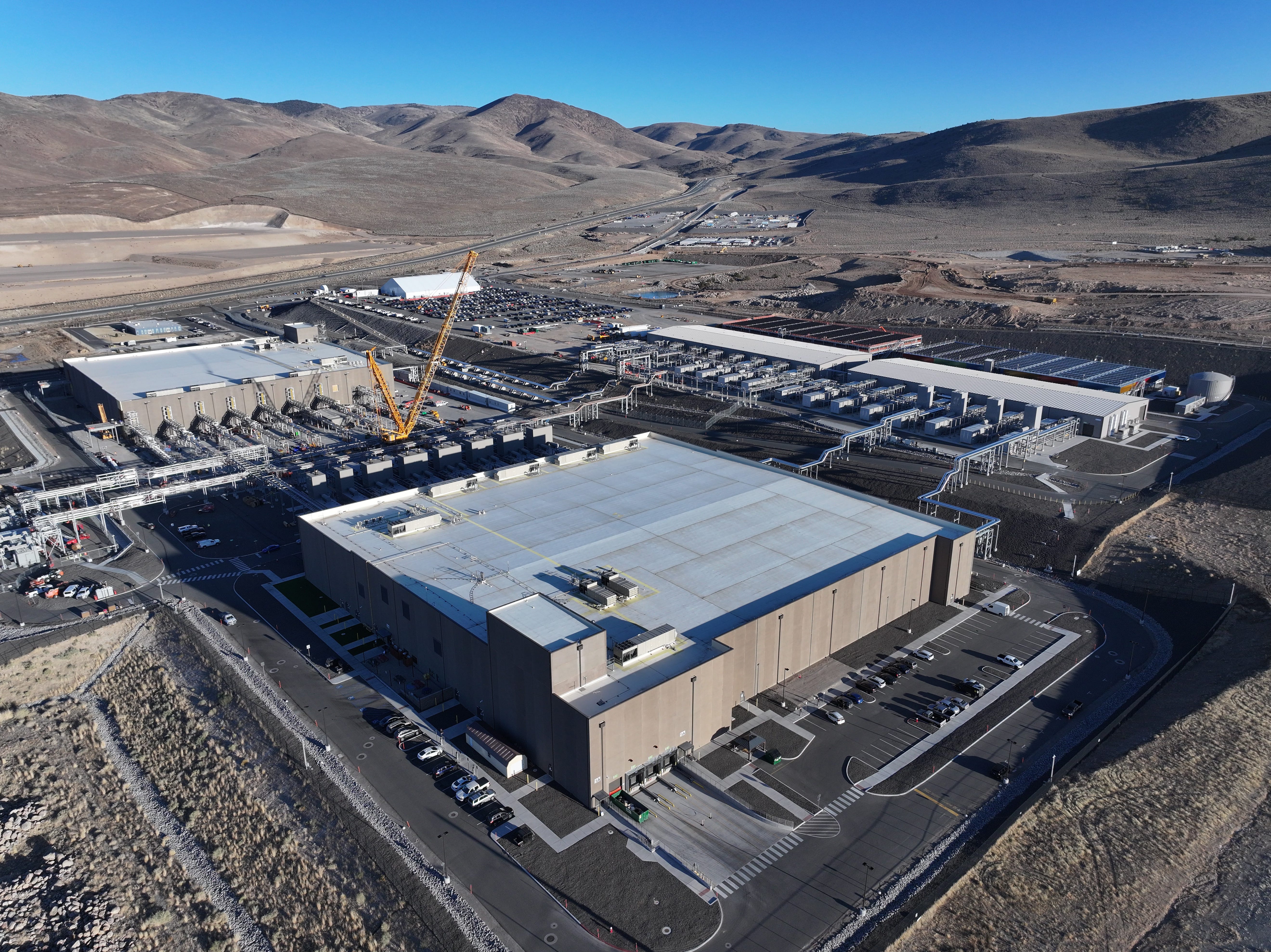
Zoom out and the numbers stop feeling like numbers. Data centers worldwide are on track to more than double their electricity use by 2030, to roughly what the entire country of Japan burns in a year. In Utah, lawmakers kept coal plants alive that were supposed to shut down, just to feed this stuff. Burning more coal to run the machines we then use to fight climate-driven wildfires. And the water. One big data center can drink what 6,500 households use, every single day. Down in Texas, the projection is data centers drawing the equivalent of Lake Mead down sixteen feet in a year. And a lot of it’s going up in the desert Southwest, because the land’s cheap and the dry air helps cool the chips. So read that twice. We’re putting the thirstiest machines we’ve ever built in the places with the least water to spare.
This is encroachment. The exact opposite of protecting what’s left. In Arizona’s Sonoran Desert, the coalition fighting the Project Blue data center near Tucson has a three-word battle cry: “Not One Drop.” In Utah, a data center sited on a stream feeding the already-shrinking Great Salt Lake drew a record wall of protest, around 3,800 formal objections, so the developer simply withdrew its water-rights application and announced it would refile, wiping the slate clean and forcing every protester to start over and pay the fee again.
People are fighting. In rooms, in actual towns. By the close of 2025 the trackers counted something like 188 opposition groups across 40 states, a dozen-plus legislatures inching toward moratoriums, somewhere around $156 billion in projects blocked or delayed in barely a year. A huge chunk of that done by regular people taking a Tuesday night off and making it weird for the developer in the suit. And here’s the part that turns the stomach. A lot of these deals get cut behind NDAs, so the folks who live there can’t even pry loose how much water the thing will drink until the bulldozers are already rolling. Public land. Public water. And we can’t see the receipts. The word public was supposed to mean something.
Okay, so where does the water actually go?
I want to slow down here, because this one took me a while to get.
There’s a hunting/conservation podcast I listen to, and the guys spent a whole chunk of an episode circling the same question nobody could answer. They knew these things “use water.” But one guy kept pushing: use it how? You pull it in at 50 degrees to cool the machines. Does it come back out? Where does it go?
The coal-plant instinct.
They reached for the coal-plant model, and that’s a smart instinct. A coal or nuclear plant sucks a river through itself and spits it back out warm. That’s “once-through” cooling, and it’s a real problem: the hot water holds less oxygen, scrambles the signals fish use to spawn, cooks the bottom of the food chain right where the pipe dumps. Some data centers work that way, and where they do, that story applies.
Where it actually goes.
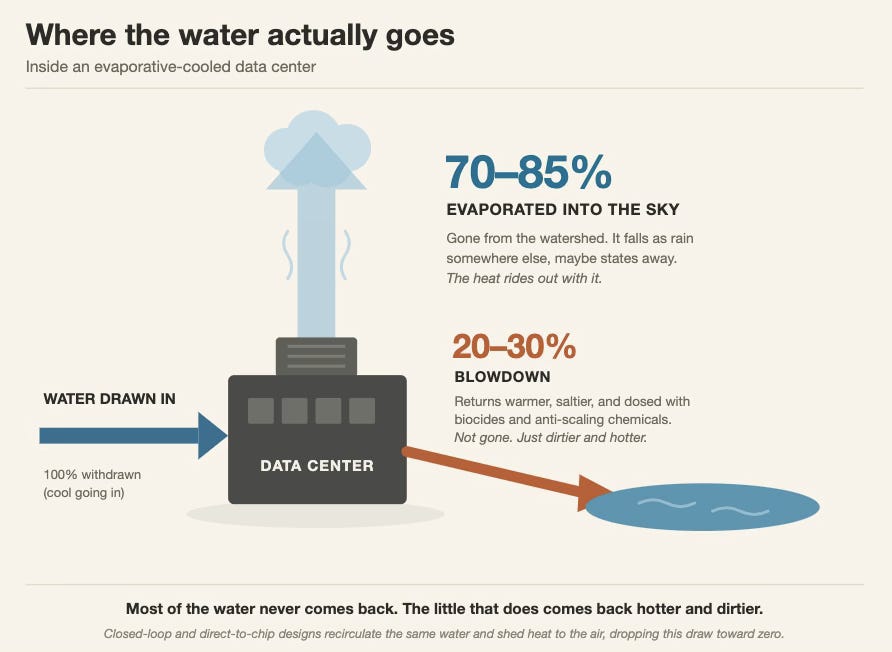
But the most water-hungry way these places dump heat, and one of the most common, is just evaporation. They run water over cooling towers and let a big slug boil off into the sky. And here’s what the guys never got to: that water mostly doesn’t come back at all. Somewhere between 70 and 85% of what an evaporative plant pulls in is simply gone, lifted into the air as vapor, not returning to that watershed until it falls as rain somewhere else entirely, maybe three states over. Google reported 78% of the water its data centers pulled was consumed that way in a single year. That’s not borrowing water. That’s spending it.
And the heat? Follow it. The whole reason evaporation cools anything is that turning water into vapor takes a crazy amount of energy, and that energy is the heat coming off the chips. So the heat doesn’t go into a river to make trouble downstream. It rides out of the building on the back of the water, straight up into the sky. You can’t cheat the physics: just about every watt you pour into a rack comes right back out as heat that has to go somewhere, and in an evaporative plant, “somewhere” is the clouds.
Doing it dry.
Can you do this without evaporating water? Sort of. The simplest version is air cooling, basically giant radiators and fans, no water boiled off. Cold-climate data centers get there easiest, for the same dumb reason your beer chills faster on the porch in January than in the fridge. When the outside air’s already cold, physics does most of the work for free.
Closed loop, and liquid cooling.
“Closed loop” gets thrown around like everybody knows it. Think of it kind of like the cooling system in your car: the same coolant goes around and around, soaks up heat off the hot parts, runs to a radiator that cools it back down, comes back, does it again. You don’t refill it. The liquid isn’t used up; it’s reused. Scale that up to a building full of scorching AI chips and you get the approach everybody’s racing toward, in three flavors.
Direct-to-chip sets little metal plates right on the hottest components, the CPUs and GPUs, with coolant running through them.
Immersion dunks the whole server in a tub of special fluid that won’t fry it.
Rear-door swaps the back of the rack for a radiator the servers’ own fans blow through. Microsoft even rolled out a “zero-water” design, a closed loop filled once at construction, that it says avoids more than 125 million liters of water a year per site.
All good advancements. Genuinely. And then the fine print.
One. Most of these only cool the hottest parts. Direct-to-chip grabs maybe 70 to 75% of a rack’s heat. But a rack’s also full of memory, drives, power supplies, that last quarter still comes off as plain hot air, and something has to remove it. Usually ordinary air-conditioning. So “liquid-cooled” almost never means only liquid-cooled.
Two, the big one. Here’s what “closed loop” hides. That sealed loop on the chip doesn’t get rid of the heat. It just carries it, over to a second system whose whole job is to throw the heat away. And the cheapest way to throw heat away is to evaporate water, same trick as sweating. So the building runs warm water over a big outdoor tower, lets a chunk boil off, and the heat goes up with the steam. That evaporated water is gone, replaced with fresh water, by the thousands of gallons a day. So both things are true at once: the loop touching the chip is sealed and reuses its water, and the building is still drinking fresh water hand over fist, one step downstream, at the tower, where you weren’t looking. Closed loop at the chip is not the same as closed loop at the building.
Three. You can build a tower that doesn’t evaporate anything, a “dry” cooler, like Microsoft’s. But that doesn’t make the cost vanish, it moves it. Dry cooling takes a lot more electricity, and the power plant making that extra electricity is itself one of the thirstiest things around. So you trade a water bill at the data center for a water bill at the power plant. Same water, different address.
So the water these things drink is a choice, usually the cheaper one, made on cheap hot land where some company decided the local aquifer could just eat the cost. The tech to not do that already exists. Whether it gets used comes down to who’s in the room asking the question.
Back to what the podcast suspected. That other 20 to 30% that does drain back out, the “blowdown”? That’s where the hunch about pollution earns a yes. You can’t cycle the same water through a tower forever, every lap leaves minerals behind and the water gets saltier and harder, so you bleed off the concentrated stuff, and by then it’s been dosed with anti-scaling chemicals, anti-corrosives, pH adjusters, and biocides to keep it from gunking up or growing Legionella in the warm tower. So what goes back to the creek comes out warmer, saltier, and full of chemicals. They were right to be suspicious.
And one more thing they circled and never landed: can’t you just pull from an aquifer, cool with it, put it back? Mostly no. First, you can’t reinject vapor, and vapor’s where most of it went. Second, even setups that return water don’t fix what the pumping does. Draw the groundwater down and you lower the water table. The one feeding the springs, the seeps, the wet meadows, the dry-season trickle that keeps a creek alive in August. We’ve seen this movie. Pump hard enough, long enough, and year-round streams go to gravel, the neighbor’s well goes dry, and in the worst cases the ground itself sinks. The water under your boots isn’t a different thing from the water in the trout stream. It’s the same water on a slower clock.
And the cruelest part is the timing.
These machines want the most cooling in August. Peak heat. The exact month rivers run lowest, aquifers run on fumes, and the alfalfa guy down the road is already fighting his neighbor for the same gallons. Not a polite sip. A spike. Right when there’s the least to spare. And that spring, that seep, that dry-season trickle? On a lot of this land that’s the watering hole every other animal in the valley walks back to when everything else has dried up.
The footprint you can’t see
The water and the slab are the parts a TV crew can stand in front of. The footprint is bigger. Once you list it out, the thing stops looking like a building and starts looking like a wound with edges that run for miles.
Start with sound. These places never sleep, and they hum. A low industrial drone off the cooling fans that carries for thousands of feet, plus diesel generators that hit 85 to 100 decibels when they fire. It’s the same physics for wildlife as for people. Animals call to find mates, hold territory, warn each other, keep a herd together. Park a permanent drone in the middle of that and you’ve jammed the frequency they’ve used for a hundred thousand years. Some just leave.
Then the lights. These places burn all night, and night light scrambles circadian rhythms, kills off melatonin, pulls migrating birds off course, and disrupt insects, the bottom of the whole food pyramid. Lose the dark, lose a piece of the system that ran on darkness.
Then the air. Those “backup” generators aren’t really backup anymore. As the grid gets squeezed, operators who swore the generators were for emergencies are angling to fire them up at peak demand so the data center can drop off the public grid. Northern Virginia alone has something like 9,000 backup diesel generators standing by. A state analysis found that at their permitted limits they’d throw off about 9,000 tons of nitrogen oxides a year, roughly half of everything Northern Virginia emits from all sources. In Memphis, xAI went straight to dozens of gas turbines in a city already named an asthma capital, and caught a Clean Air Act lawsuit for running them without permits. That exhaust isn’t an abstraction. It’s tied to heart disease, lung disease, and cancer, settling over whoever, and whatever, lives downwind.
Then the wires. A facility pulling as much power as a small city reaches. New high-voltage corridors get cut to feed it, and a corridor is a permanent clearing, a scar that opens the inside of a forest to invasive species and easier predation. Run that across a national forest and you’ve turned one contiguous piece of wild into two pieces with a wound down the middle. The building’s got a fence line. Its impact does not.
And that’s just the building. There’s a whole second water bill upstream nobody puts on the ledger: the chips get made in semiconductor fabs that can swallow ten million gallons of ultrapure water a day, with wastewater carrying heavy metals and acids; many of these places run on fracked gas with its own buried water cost; and the chips go obsolete in two or three years, so the whole filthy supply chain runs again and again at the speed of a software update. But most of that bill comes due in Arizona or Taiwan, not on the national forest down the road. So set it aside, and look at what’s happening to the land right here.
The honest bar
Here’s the question I can’t stop chewing on, the one a working biologist would ask before anybody panics. Is any of this population-level?
Because that’s the honest bar. Wind turbines kill birds, and the industry will tell you, correctly, it isn’t population-level. Cars kill raccoons by the thousands, and that isn’t either. By that same clear-eyed standard, one data center’s slab, the birds confused by its lights, the handful of critters it shoves out. No, that probably doesn’t tip a whole species over the edge. And I want to be as honest about that as I’d want the wind guys to be about their turbines. Same standard cuts both ways or it doesn’t cut at all.
But this is exactly where the framing pays off, because it points you at the thing that actually matters, and it’s not the slab. It’s the straw in the aquifer. The pull on the river. Multiplied across hundreds of these in one basin, all peaking in August at the same time. That has population-level written all over it. Pull the dry-season flow out from under a creek and you haven’t killed one animal. You’ve taken away the watering hole every other animal in the valley walks back to when everything else has dried up.
Habitat doesn’t need to get bulldozed to be lost. Sometimes all it has to do is go thirsty at the wrong time of year.
So what’s the actual answer here
Net positive or net negative? I don’t think that’s even the right question, because the two sides aren’t the same kind of thing.
Remember the poachers? I won’t pretend that away, because it’s the honest counterweight. Sometimes the watching does turn into something real. A tracked boat becomes a protected reef. Information becomes actual fish in actual water. So it’s not nothing. But look at the shape of the ledger. The upside is information, and information is slippery, it only helps if somebody acts on it, and it can get bought, buried, NDA’d, ignored. The downside is physical. A drained aquifer is just gone. One side of the scale is a maybe. The other is a hole in the ground. That’s why the math doesn’t add up. It never did.
Here’s my one rule. When somebody tells you AI is going to save nature, don’t nod along. Push back.
AI’s here. It’s not going anywhere. And it could do real good in a hundred other corners of life: medicine, materials science, grid efficiencies, climate models, genomics, and much more. I’m not anti-AI. Not anti-progress. I want AI to help human existence, and our environment. We need to invest in this properly. Spending more for truly closed loop and non evaporative practices, that are powered from cleaner energies.
The upside to AI is mostly information with the potential for physical value. It helps us see. See the dark boat. See the early smoke. See the next cure. The downside is always physical. A drained aquifer is just gone.
And under all of it is an assumption I want to drag into daylight: that nature is a problem to be monitored and managed. That more sensors plus more data plus a little more cleverness somehow stacks up to more nature on the other end.
It doesn’t.
The fire story proves it cold. We measured. We managed. We suppressed. And we walked ourselves straight into the biggest fires this continent has ever seen. The places doing best right now aren’t the ones we’ve instrumented to the eyeballs. They’re the ones we’ve left alone enough to keep doing their own work.
You want to know where I actually landed on this? In South Africa, of all places. A couple weeks out there with no service. No Wi-Fi. No TV. Just me and my own thoughts long enough that I got bored enough to actually run them down to the end.
And the line I scratched into a notebook was this. As the noise goes down, the signal comes clear.
That’s the whole essay, honestly.
Because nature handles nature. Always has. It’s better at this than we are by a country mile. The forest knows when to burn. The ocean knows how to come back. Our job was never to bolt a nervous system onto it. Our job is smaller, and harder. Protect what’s still here. Don’t let things creep onto it. And then, mostly… step back.
So here’s the doable thing, the one within reach for someone like you, or me. Find out what’s getting built near the wild places you love. The trackers are out there. The county agendas are public record. Show up. Ask the boring questions right out loud, in front of everybody. How much water. How much power. Where does the discharge go, and how hot when it gets there. Whose aquifer. Who pays. Who profits.
That question, asked in public, on the record, is the single sharpest tool any of us has. And roughly $156 billion in stalled projects pretty much closes the case on whether it works.
Because the forest doesn’t need us to listen in. It’s been talking to itself, beautifully, for a long time before any of us got here.
It just needs us to quit building things on top of it.
I’ll leave you with a question. When there’s a drought somewhere in the United States, who gets the water… the people, or the billion-dollar AI company?
Thank you for reading! Wild places don’t come back. Conservation Current tracks the policies, projects, and decisions eating away at America’s public lands, and holds the energy industry accountable when it takes the easy path over the right one. I believe in clean energy and progress but it must be done ethically.
I write this, build this, and fund this myself. If you find any value in this, a coffee goes a long way.
Check out The Conservation Current Public Land Policy Tracker surfaces the five most impactful open comment periods and regulatory actions on federal public lands. Ranked by scale, irreversibility, and deadline urgency. Updated weekly. Always verify deadlines at regulations.gov before submitting.
Sources
Fire and detection
- “States across the wildfire-prone Western US are using AI for early detection,” KPBS / Associated Press, May 2026.
- “Wildfire Management: Technologies for Forecasting, Detection, Mitigation, and Response,” U.S. Government Accountability Office, June 2025.
AI, satellites, and illegal fishing
- “Satellite imagery detects illegal fishing activity, shows strict protections work,” Phys.org, July 2025 (covering the study in *Science*).
- “‘The ocean is no longer too big to watch,’” Space.com, July 2025.
**Where the cooling water goes (evaporation, discharge, closed-loop)**
- “Data Centers and Water Consumption,” Environmental and Energy Study Institute — ~80% of withdrawn water evaporates; consumption-vs-withdrawal; the three-part footprint including chip manufacturing.
- “Myths vs. Reality: Data Centers and Water Usage,” Florida Water and Pollution Control Operators Association — 70–80% lost to evaporation, 20–30% returned as warm “blowdown.”
- “Data Center Water Use,” MOST Policy Initiative, April 2026 — Google fleet 78% consumed; salinity/temperature in discharge lowering oxygen; *Legionella* risk.
- “Understanding water use at Microsoft datacenters,” Microsoft, March 2026 — evaporative cooling above 85°F; zero-water direct-to-chip closed-loop.
- “Cooling Without the Drain,” Vantage Data Centers, April 2026 — sealed-loop cooling and treatment additives.
Groundwater, baseflow, and drawdown
- “Ground-Water Depletion Across the Nation,” U.S. Geological Survey — reduced stream baseflow; land subsidence; saltwater intrusion.
- “Rural Texas casting skeptical eye on data center openings,” Texas Tribune, October 2025 — Ogallala Aquifer concerns.
- “Data Centers and Their Implications for Rural Communities,” Oklahoma Farm Report, April 2026 — Texas rule of capture; pumping without compensating neighbors.
Noise, light, diesel, and air
- “Communities Are Raising Noise Pollution Concerns About Data Centers,” EESI, March 2026.
- “Understanding the impact of data center noise pollution,” TechTarget — generators at 85–100 dBA; noise disrupting wildlife.
- “The Dangers of Data Centers,” Environmental Health Project, February 2026 — all-night lighting and circadian disruption.
- “Data Centers,” Nature Forward, February 2026 — ~4,000 diesel generators in Northern Virginia; transmission-line impacts.
- “State regulators weigh expanded use of data centers’ diesel backup generators,” VPM, December 2025 — worst-case 9,000 tons of nitrogen oxides.
- “From Energy Use to Air Quality,” World Resources Institute — xAI’s Memphis gas turbines and the Clean Air Act challenge.
Upstream supply chain and e-waste
- “Semiconductor manufacturing and big tech’s water challenge,” World Economic Forum — a fab using ~10 million gallons of ultrapure water/day; heavy-metal wastewater.
- “AI Hardware Environmental Impact,” AI Energy Calculator, September 2025 — AI hardware obsolete in 2–3 years vs. 5–7 for general servers.
- “Data Centers and the Water Crisis,” Science and Environmental Health Network, August 2025 — the often-uncounted water cost of fracked gas.
Federal land, scale, and pushback
- “DOE Announces Site Selection for AI Data Center and Energy Infrastructure Development on Federal Lands,” U.S. Department of Energy, July 2025.
- “Energy and AI” (Executive Summary), International Energy Agency, 2025 — global data-center electricity roughly doubling by 2030.
- “Data Drain: The Land and Water Impacts of the AI Boom,” Lincoln Institute of Land Policy, February 2026 — Texas water use and the Lake Mead comparison.
- “A massive AI data center transforms rural Utah into a national flashpoint,” Peoples Dispatch, May 2026.
- “Opposition to AI data centers,” Wikipedia — ~$156 billion in projects delayed or canceled in 2025; state moratoriums.
This was a lot of hard work. You should get in touch with meateater if you haven’t already. They’d probably at least read your letter on air