


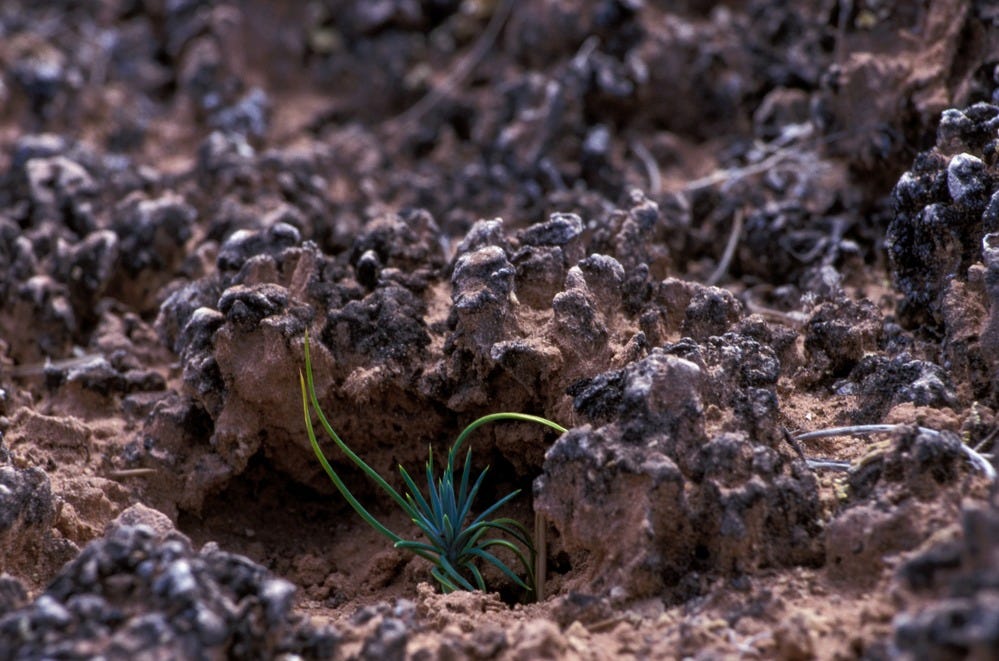
Walk across the Colorado Plateau and you’ll see it. Dark. Lumpy. Almost alien. A strange, textured surface coating the ground between the shrubs.
It doesn’t look like much.
Step on it and you’ll hear a faint crunch. That sound is up to 120 years of biological work being destroyed in a single stride. In some cases, more than a thousand.
It’s called a biological soil crust. Biocrust. A living community of cyanobacteria, lichens, mosses, and fungi woven into the top few millimeters of the earth’s surface. In the undisturbed stretches of the Great Basin and the Colorado Plateau, biocrusts can cover up to 70 percent of the ground between plants.
Most people have never heard of them.
They fix nitrogen into the soil. They lock carbon out of the atmosphere. They bind the surface particles together so the desert doesn’t blow away. USGS researchers describe them as a cornerstone of dryland health.
Biocrusts cover roughly 12 percent of the Earth’s entire land surface, according to a 2018 global mapping study published in Nature Geoscience. In arid and semi-arid regions, which make up about 40 percent of all land on Earth, they dominate the ground between plants. They are the dominant life form under your feet across a massive portion of the American West.
And we are scraping them off to build solar panels.
That sentence deserves to sit for a second.
The Bureau of Land Management manages 245 million acres of federal public land, most of it across the arid West. Dozens of large-scale solar projects have been approved or are currently being permitted across this landscape. The Biden administration pushed hard on this. The logic made sense on paper: federal land is vast, the sun is relentless, we need the power.
But there’s a problem. A quiet, slow, generational one.
When a utility-scale solar array goes in, the ground gets graded. The biocrust gets scraped off. USGS Research Ecologist Jayne Belnap, admitted to the National Academy of Sciences largely for her work on Western biocrusts, documented what recovery looks like after mechanical disturbance in the Mojave Desert. Cyanobacterial crusts need about 120 years. Mosses take up to 766 years. Lichens, the most complex and ecologically important component of mature crusts, may need somewhere between 2,000 and 3,800 years to recover.
A solar array has a lifespan of about 30 years.
The panels get decommissioned, upgraded, replaced twice over. The desert is still at year one of its recovery.
There’s another piece of this that doesn’t get talked about much. Biocrusts are the primary reason desert soils don’t blow away. A 2022 study in Nature Geoscience found that biocrusts reduce global atmospheric dust emissions by approximately 60 percent. When they’re destroyed across large areas, the dust suppression disappears. Bare soil becomes mobile. Invasive grasses move in. Wildfire risk climbs. The damage doesn’t stop at the fence line.
Speaking of fence lines.
Federal law requires utility-scale solar facilities to be fenced. The standard is chain-link or woven wire, at least six feet tall. That fence solves a security problem and creates an ecological one. Pronghorn, mule deer, elk, and bighorn sheep cannot get through it. Pronghorn especially, because unlike deer and elk, they don’t jump. They crawl under. Woven-wire fencing at ground level is essentially a wall to them.
Research published in the journal Ecosphere in 2022 found that pronghorn encounters with fencing significantly alter their movement, and in some cases block it entirely. The average pronghorn in one Wyoming study encountered a fence 248 times a year. A separate University of Wyoming study found that a single fence block in the Red Desert excluded pronghorn from more than 104,000 acres of habitat. The Wildlands Network is currently running the only known GPS-collar study of pronghorn near utility-scale solar, tracking 75 female animals around an 1,100-acre facility in New Mexico. The research is ongoing because frankly, nobody has studied this enough before approving thousands of acres of fenced solar on the same landscapes these animals migrate across.
This is the part of the clean energy story that rarely makes it into the press release. Biocrusts scraped. Migration corridors fenced. Both happening on public land, on habitat that evolved over thousands of years, to power a future that could theoretically be built somewhere else entirely.
Because here’s what makes all of this genuinely hard to excuse.
We don’t need to build on any of it.
The DOE’s own Solar Futures Study, published by the National Renewable Energy Laboratory in 2021, found that the largest possible solar buildout scenario for the entire country through 2050 requires about 10.3 million acres. That number sounds large until you look at what the EPA has already mapped.
The EPA’s RE-Powering America’s Land Initiative has pre-screened more than 190,000 contaminated sites covering over 43 million acres for renewable energy development. Brownfields. Superfund sites. Former landfills. Abandoned mine lands. Land that isn’t doing anything, has no functioning ecosystem, and in many cases already has road access and transmission infrastructure nearby. A Center for American Progress analysis of that same EPA data found those sites could host more than 940 gigawatts of clean energy. We need 10.3 million acres. The EPA has pre-identified 43 million.
The choice to build on intact public land is an economic and permitting preference. Public land is cheaper. Federal approvals can be faster than navigating brownfield redevelopment. The companies building these projects are making a rational business decision and that decision keeps landing on wild public land when the alternative is sitting pre-mapped, pre-screened, in every state in the country.
There is a reason this story doesn’t get told. Biocrusts don’t have a charismatic spokesperson. There’s no endangered crust to put on a poster. They look like dirt. Pronghorn do have advocates, but the specific research connecting solar fencing to population-level effects is still being collected because the permitting happened faster than the science.
Solar is essential. The grid has to change. None of that is the argument.
The argument is that we keep choosing whose land gets sacrificed for that future, and the choice keeps landing on wild public land, on ancient soil communities, on migration routes that predate every fence ever built in this country. We are making that choice when we don’t have to. The degraded land is already there, waiting, pre-screened by the federal government itself.
The desert is patient. We are not.
Thank you for reading! I highlight threats to public lands and the energy industry’s impact. I believe clean energy is the future, and ALL energy projects should prioritize private land first to keep wild places wild. When energy extraction is needed on public lands all projects must restore the land after extraction. Public lands are unique and once lost, they’re gone forever.
Sources
Rodriguez-Caballero, E. et al. (2018). “Dryland photoautotrophic soil surface communities endangered by global change.” Nature Geoscience, 11, 185-189.
Rodriguez-Caballero, E. et al. (2022). “Global cycling and climate effects of aeolian dust controlled by biological soil crusts.” Nature Geoscience, 15, 458-463.
Elbert, W. et al. (2012). “Contribution of cryptogamic covers to the global cycles of carbon and nitrogen.” Nature Geoscience, 5, 459-462.
Belnap, J. and Warren, S.D. (2002). “Patton’s tracks in the Mojave Desert, USA: an ecological legacy.” Arid Land Research and Management, 16, 245-258.
Belnap, J. and Eldridge, D.J. (2003). “Disturbance and recovery of biological soil crusts.” In Biological Soil Crusts: Structure, Function, and Management. Springer.
Ferrenberg, S., Reed, S.C. and Belnap, J. (2015). “Climate change and physical disturbance cause similar community shifts in biological soil crusts.” PNAS, 112(39).
U.S. Department of Energy / NREL. (2021). Solar Futures Study. DOE/GO-102021-5608. energy.gov
EPA RE-Powering America’s Land Initiative. Mapper updated June 2022. epa.gov/re-powering
Center for American Progress. (2023). “How States Can Turn Polluted Lands Into Clean Energy.” americanprogress.org
once the soil biome has been destroyed worldwide we are done for