


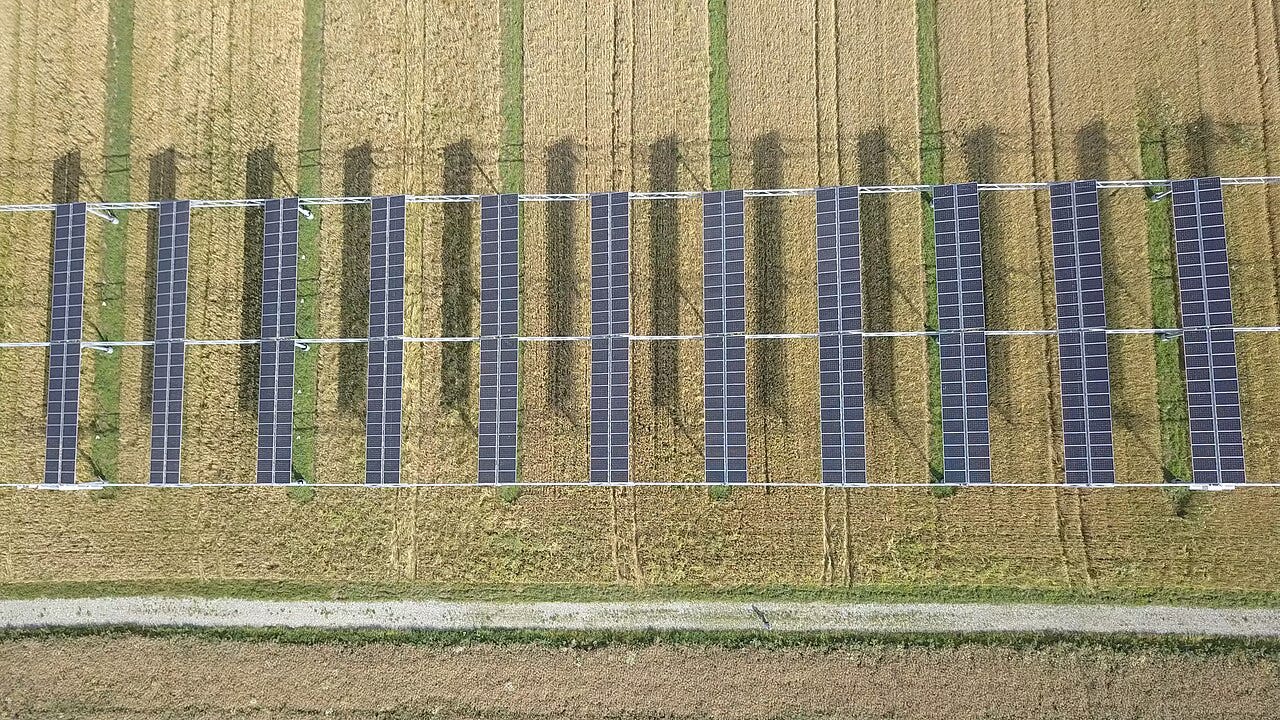
You’ve heard the press-release version. Farmers double their income, crops grow better under panels, water use drops, pollinators return, America solves the land-use conflict between agriculture and clean energy in one elegant move.
Parts of that are true. Most of it isn’t, or isn’t yet, or only is in places nobody’s actually building.
The peer-reviewed work from the last two years has at least moved the conversation somewhere useful. Agrivoltaics isn’t a vibe anymore. It’s a proposition that works in some places, for some crops, under some conditions, and doesn’t work in others. That’s what I want to lay out.
What are we actually talking about.
Definitions first. Agrivoltaics means solar panels and farming on the same land at the same time. In the U.S., the dominant form by acreage is sheep grazing under utility-scale arrays, about 113,000 sheep on 129,000 acres across more than 500 sites, per the 2024 Solar Grazing Census. Sheep sites are huge, so they swamp the other forms of agrivoltaics in the totals. The harder, more interesting version are row crops grown under or between elevated panels. That is where most of the recent science is. And where the trouble is.
Start with land and water.
The industry uses something called the Land Equivalent Ratio. The idea is simple: if you’d need 1.5 separate acres of solar and farmland to match what one shared acre produces, the LER is 1.5. Higher means more efficient use of land. Real-world agrivoltaic systems in peer-reviewed studies land between 1.2 and 1.8. That’s a real number. It’s good.
But LER doesn’t pay the bills. In one case, a Belgian pear orchard yielding 15% fewer pears while generating roughly 240 megawatt-hours per acre per year uses land 44% more efficiently than separating the two, and still loses money. Semi-transparent panels on elevated supports cost roughly twice per watt what utility-scale solar does, generate 60% as much electricity, and the 15% fruit shortfall costs 6,000 euros per hectare on top. Producing electricity at 200 euros per megawatt-hour into a market that pays 60–100 doesn't pencil out, no matter how efficiently you're using the land.
Water is where the case gets strongest, especially in the American West. A 2025 systematic review of 33 studies found agrivoltaic systems cut irrigation needs by 20–47%. The mechanism isn’t mysterious: panels shade the soil, slow evaporation, drop air and ground temperatures by 1.8–7.2°F. Moisture stays in the ground longer. Less watering.
A 2025 University of Arizona trial cut irrigation 50% under panels. Anasazi beans actually outperformed fully irrigated controls in the open field by 14%. Tomatoes held steady. Basil dropped 21%, rough, but better than the 39% it lost in full sun under the same water cut. Panels don’t erase drought stress. They take the edge off. In the Southwest, where water is existential, that’s the whole game.
Now the uncomfortable part.
A March 2026 PNAS study modeled agrivoltaics across the Midwest using fifteen years of climate data. Results split sharply along one variable: aridity. In drier western areas (Nebraska, Kansas) soybean yields rose 6%. In the humid eastern Corn Belt, (Illinois, Indiana, Ohio) soybean yields fell 16%, and modeled corn losses ran as high as 24%.
The reason is obvious once you see it. In hot dry climates the crop is being cooked, and shade helps. In cool, cloudy, or humid climates sunlight is already the limiting factor. Take more away and yields fall. There’s no engineering around that.
Corn is the worst case. One of the most light-hungry crops in agriculture. Even at Purdue, where researchers ran multi-year trials with custom algorithms tilting panels away from the plants during critical growth windows, the average yield reduction was about 7.7%. That’s the best engineered result. Most commercial setups do worse.
Two problems in this space deserve more attention than they get. First: do your panels match your tractor. A 2026 peer-reviewed analysis found that when panel spacing doesn’t line up with the working width of farm equipment, field efficiency drops to 45%. Makes sense. Buffer zones eat 30% of usable land in some designs. Second: soil compaction. A German field study estimated 5-6% yield losses across a site purely from vehicle traffic during installation. That’s comparable to the shading penalty. You’ll basically never see it in industry materials.
The economics are blunt. Solar carries the case. In essentially every financial analysis from 2024 through 2026, electricity revenue dwarfs crop revenue. Agrivoltaics works when it’s designed as a solar project that keeps farming alive, not a farm with panels bolted on. A 2025 Cornell study modeled the best use of land across seven crops and found pure solar won every matchup except cabbage. That tells you where the money is.
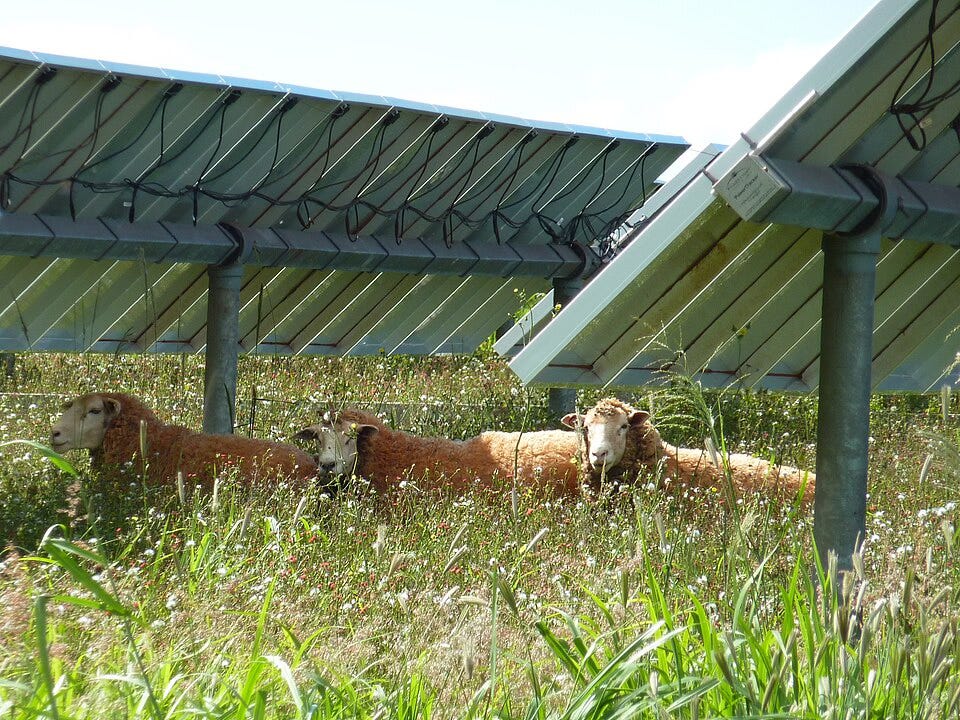
Sheep grazing, the dominant U.S. form of agrivoltaics, is the cleanest economic story. A 2025 model found ROIs of 16–43% and graziers earning around $194 per acre per year in vegetation management fees. It works because it solves a real problem for solar developers: cutting vegetation under panels is expensive. Sheep do it for free and pay you to do it.
Crop-based systems without subsidies are harder. You need high electricity prices, high-value crops, or water savings you can actually monetize. The IRA’s stacked credits, up to 50% of capital costs for qualifying utility-scale projects in eligible rural areas, move the needle.
Here’s the finding that bothered me most. A 2024 Penn State qualitative study interviewed farmers and solar workers in Pennsylvania and found that nobody, in any case observed, had negotiated agrivoltaic-specific terms into their solar lease. Standard land leases. No requirements for elevated panels. No protections for continued farming. No yield guarantees. The dual-use story was in the IRA pitch. It was not in the contract.
The environmental picture is cleaner. A five-year study at two Minnesota solar sites, in Environmental Research Letters, found native bee abundance up 20-fold, total insects tripled, flowering plant species richness up 7-fold. Pollinator activity rose on adjacent soybean fields too, the benefit spills past the fence.
Soil carbon depends on the system. A 2025 analysis found tracking systems built up soil organic carbon while fixed-tilt systems in dry environments actually lost 0.46 kg per square meter. The blanket “solar is good for soil carbon” claim doesn’t hold.
A 2024 life-cycle assessment found well-designed agrivoltaic configurations have 15–55% lower overall environmental impact than solar-only development, mostly because you don’t have to clear separate land. They also use more steel and structural material than standard ground-mount, which carries its own upfront carbon cost. Both things are true.
So where does this actually work in the U.S.?
The Southwest and California’s Central Valley are the strongest fit. Sun, water stress, heat-sensitive crops, irrigation pressure, all the advantages stack in the same place.
The western edge of the Corn Belt, Nebraska, Kansas, eastern Colorado, is the best near-term row-crop opportunity. Soybeans like partial shade in dry conditions. Irradiance is high. The Ogallala is in trouble. Anything that cuts irrigation pays back.
The Northeast has the highest electricity prices in the country and the most generous state programs. Specialty crops, not commodity grains.
The humid eastern Corn Belt is the worst fit for commodity crops. 24% corn losses in peer-reviewed modeling are not the kind of problem better engineering fixes when sunlight is the constraint.
Agrivoltaics is not a scam. It is also not a silver bullet. It’s a land-use tool that fits some places and not others. It works when the land is water-stressed, the crop tolerates shade, the system was designed with farming in mind from day one, and the contract actually protects the farmer. It struggles when the crop is corn in a humid climate, when the panels were an afterthought, when the deal is a standard solar lease with some agricultural language stapled on.
The question has shifted. It’s not “does agrivoltaics work” anymore. It’s where, with what crop, in what configuration, under what policy. Those questions don’t fit on a press release.
Let’s keep studying and hacking away at this solution.
Pursuing this, keeps solar off pristine desert soil, prairie land, and other public lands ecosystems. It should be pursued and further studied.
Thank you for reading! Wild places don’t come back. Conservation Current tracks the policies, projects, and decisions eating away at America’s public lands, and holds the energy industry accountable when it takes the easy path over the right one.
I write this, build this, and fund this myself. If you find any value in this, a coffee goes a long way.
Check out The Conservation Current Public Land Policy Tracker surfaces the five most impactful open comment periods and regulatory actions on federal public lands. Ranked by scale, irreversibility, and deadline urgency. Updated weekly. Always verify deadlines at regulations.gov before submitting.
Sources:
Solar grazing scale (113,000 sheep / 129,000 acres) https://solargrazing.org/wp-content/uploads/2025/06/ASGA-CensusReport2024.pdf
Belgian pear orchard (15% yield reduction) https://link.springer.com/article/10.1007/s13593-025-01019-0
Systematic review of 33 studies (20–47% irrigation reduction, 1–4°C cooling) https://www.sciencedirect.com/science/article/abs/pii/S1364032125006033
University of Arizona crop trial (Anasazi beans, tomatoes, basil under 50% irrigation cut) https://www.nature.com/articles/s44264-025-00073-1
Central Valley solar / water savings for ~27 million people https://www.nature.com/articles/s41893-025-01546-4
Midwest agrivoltaics modeling (24% corn loss, 16% soybean loss, 6% gain in west) https://www.pnas.org/doi/10.1073/pnas.2514380123
Purdue corn study (7.7% average yield reduction) https://www.nature.com/articles/s44264-026-00141-0
Companion paper: https://www.cell.com/cell-reports-sustainability/fulltext/S2949-7906(24)00234-9
Farm equipment compatibility (field efficiency drops to 45%, 30% buffer-zone loss) https://www.sciencedirect.com/science/article/pii/S1364032125013346
German soil compaction during installation (5–6% yield loss) https://www.tib-op.org/ojs/index.php/agripv/article/view/2852
Cornell land-allocation optimization (cabbage as the only exception) https://www.sciencedirect.com/science/article/abs/pii/S0306261925001667
Sheep grazing economics (16–43% ROI, vegetation-management fees) https://news.westernu.ca/2025/01/solar-sheep/
Penn State qualitative interviews (no agrivoltaic-specific terms in observed leases) https://pure.psu.edu/en/publications/just-energy-imaginaries-examining-realities-of-solar-development-/
Minnesota biodiversity (native bees 20-fold, insects tripled) https://iopscience.iop.org/article/10.1088/1748-9326/ad0f72
Soil organic carbon (tracking vs fixed-tilt, 0.46 kg/m² loss) https://www.sciencedirect.com/science/article/abs/pii/S0301479725019139
Life-cycle assessment (15–55% lower environmental impact than PV-only) https://www.sciencedirect.com/science/article/abs/pii/S0048969723079044
Has anyone been doing work on edge effect on cropping land adjacent to solar projects? If beneficial insect populations are growing in solar projects pesticide use could be minimised. Having mosaic PV installations in cropping land could have many collateral benefits on yield and reduction in chemical usage.
Cows need shade too